
| blog


Nicus Bothma
January 15, 2026
Built for the Way Pricing Teams Think
Built for the Way Pricing Teams Think
Pricing teams are a capable, analytical, and creative group. It is therefore no surprise that they develop thoughtful and often sophisticated approaches to pricing risks. Any tool designed to support this work must strike a careful balance. Pricing teams want the freedom and simplicity of Excel, combined with the performance, reliability, and discipline of production-grade code.
At the same time, pricing teams operate in an environment where experiments run in parallel, assumptions change frequently, and regulatory scrutiny demands clear and defensible decision-making. A modern pricing platform must support creativity and experimentation without compromising control or governance. Whilst many teams have adopted software engineering tools such as Git to manage this complexity, these tools were not designed with actuarial workflows or regulatory requirements in mind.
Pricing as a Set of Building Blocks
An insurance premium is not a single calculation, but the result of many smaller artefacts, or components as we refer to them. Each component acts as a building block that contributes to the overall rating structure. The Exakt platform is designed around this idea and allows users to define and combine a clear set of core components.
Exakt brings together the power of a low-code platform and an intuitive interface, enabling components to be assembled into complete rating structures. However, rather than embedding assumptions directly into code, pricing logic is expressed by composing versioned components such as constants, lookup tables, and models. This makes complex structures easier to understand, test, and maintain, without relying on complex branching strategies or duplicated logic.
Core Rating Components
The core components supported by the platform include constants, lookup tables, and models, each versioned independently and governed explicitly.
Constants define fixed values that change over time, such as VAT, inflation assumptions, or policy fees. When a value changes, the constant is versioned once, and every rating structure that references it can immediately reflect the update without modifying underlying logic.
Lookup tables provide a flexible foundation for traditional rating, translation, and mapping use cases. By versioning lookup tables independently, pricing teams can easily test combinations such as updated direct channel costs alongside existing broker commissions, without duplicating tables or creating parallel code paths.
Models are model objects that can be created within the Exakt Modelling module or developed externally and imported into the platform. When a new model version is delivered, it is added as a new component and can be tested against existing structures without rewriting integration logic. Together, these components can be configured to model virtually any scenario found in production rating systems.
Different Components, Different Cadences
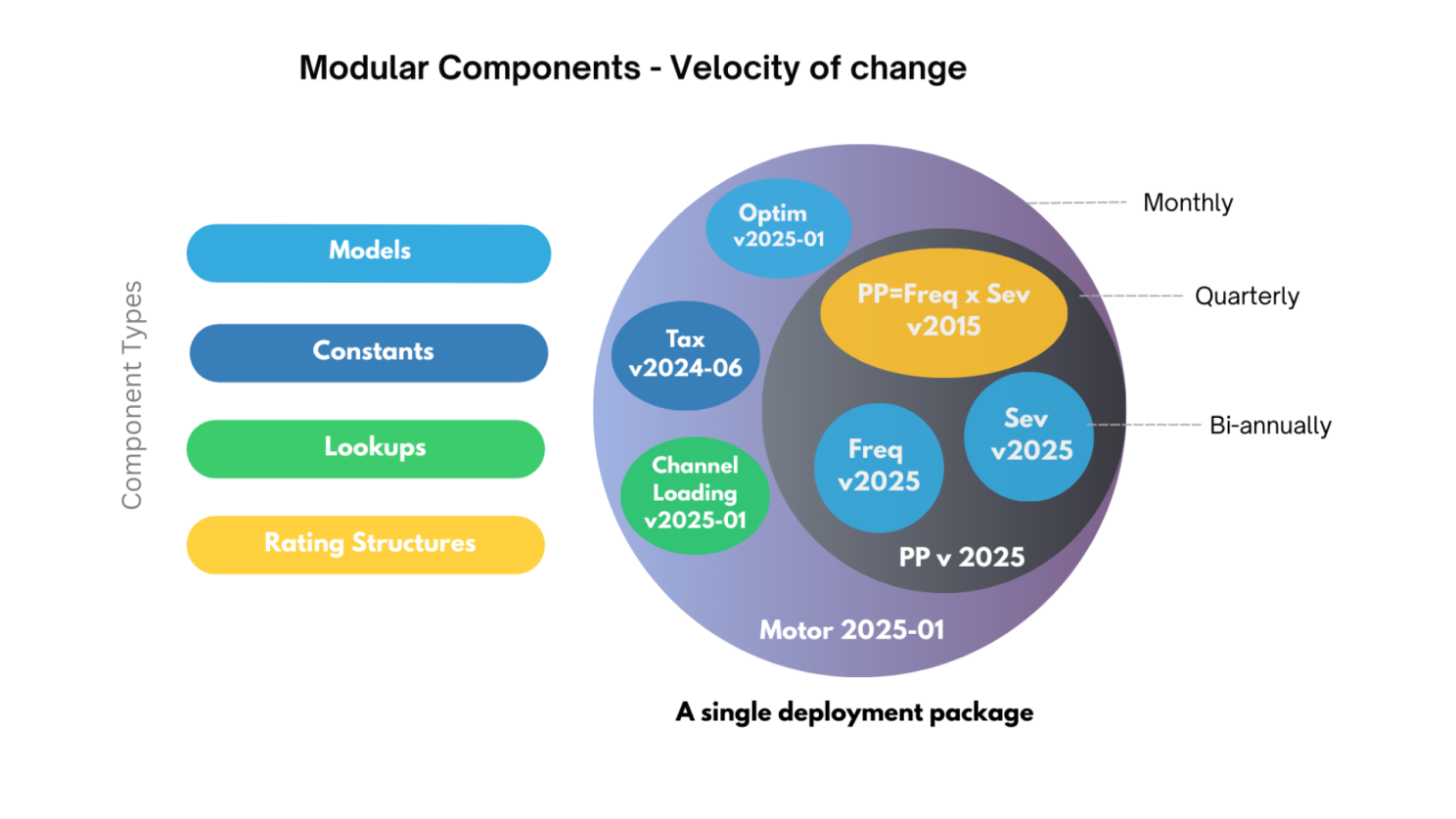
Not all components change at the same pace. Risk models, which form the actuarial foundation of pricing, might be refreshed annually following a comprehensive review cycle. In contrast, acquisition costs and demand models often require more frequent updates, monthly or even weekly, as market conditions shift, campaign performance evolves, or competitive dynamics change. By versioning each component independently, Exakt allows pricing teams to update fast-moving elements without triggering a full rebuild of the rating structure or unnecessary recertification of stable components. This separation of concerns means teams can respond quickly to market changes whilst maintaining rigorous governance over their core rating logic.
From Components to Governed, Deployable Pricing Logic
In insurance pricing, a single table or model rarely determines the final price. Most products rely on multi-peril structures that combine several models, tables, and layers of business logic. Whilst other disciplines can deploy a single model, insurance pricing requires multiple components working together to produce a premium.
To support this, Exakt includes a package builder that allows pricing teams to visually stitch components together. Code Components allow users to combine constants, lookup tables, and models with custom business logic.
This is where Exakt fundamentally differs from generic version control systems. Tools like Git track changes to files, not business concepts. This means testing scenarios—like deploying a new accident pure premium model alongside existing models and updated expense loadings—requires multiple branches and careful merge management. Experimentation quickly becomes entangled with code management overhead.
In Exakt, these same scenarios simply involve selecting component versions. Pricing teams can assemble configurations by choosing which model, lookup table, or constant version to use, without duplicating logic or managing parallel branches. Each component carries its own version history, approval status, and business context.
The resulting deployment package can be executed directly within Exakt or exported as a Python object for external deployment. Because governance is embedded at the component level, every deployed price is fully traceable to the exact (no pun intended) combination of component versions used. This ensures that pricing changes are deliberate, controlled, and auditable by design.
Structured, Flexible and Production-Ready
With all components assembled into a single deployment package, pricing teams have the building blocks needed to express complex rating logic in a clear, modular and maintainable way. By focusing on structure, component-based versioning and pricing-specific governance, the Exakt platform enables teams to work quickly and creatively whilst maintaining the control, transparency and auditability that modern insurance pricing demands.